How Much is Your Community Really Worth? The Complete Guide to Community Valuation

In short
How to value an online community, whether it is a Facebook group, a Slack channel, or a Skool or Circle space. This guide covers what drives value, how communities are priced on annual profit, what transfers, and where deals break.
Have you got your eye on a Facebook group, a Circle community, or a Slack channel and want to know what it is worth? Or perhaps you built one and are thinking about selling. Either way, pricing a community is harder than pricing most digital assets. A community is not passive income; it needs ongoing attention, moderation, and content to hold its value. But an engaged community is a real asset, and a well-run one is often worth more than its owner expects.
This guide breaks down what drives a community's value, how it is priced on annual profit, and what actually transfers when it changes hands.
Two kinds of community acquisition
Before valuing anything, it helps to know which kind of deal you are in. There are two, and they price very differently.
Member acquisitions are about the audience. The buyer wants to grow their own reach by absorbing your members, and the value sits in the size and quality of the membership base rather than current revenue. These are more common for smaller communities. Due diligence is usually light: platform access and membership statistics. Offers tend to be modest, because a buyer who could reach similar people through paid ads has a cheap alternative, so headcount alone rarely commands a premium unless the members are highly engaged or genuinely hard to reach.
Community brand acquisitions are about the whole asset: the audience, the brand reputation, and the revenue streams. These involve more established communities with a loyal following and a recognised name in their niche. The buyer might come from an adjacent industry, provided the audience fits. Expect thorough due diligence across finances, engagement, and growth potential. Our guide to due diligence on a sub-$500k digital business covers what a serious buyer will ask for.
How to value a community
Whichever kind of deal you are in, several factors go into a fair price. Here is what matters.
Membership quality
Start with the membership base. Numbers matter less than activity. A group of 10,000 inactive members is worth far less than a smaller, tight-knit group where a large share of members regularly take part. Buyers want to see people posting, replying, and contributing, not lurking. A community that is mostly silent will not command a high price whatever its headcount.
Monetisation and added value
Next, look at how the community earns and what else it offers beyond membership fees. Common revenue and value drivers include:
- Commercial sponsorships: businesses paying to reach the audience.
- Collective intelligence: the data and insight generated through discussion, which can be a genuine business resource.
- Pre-sales and product testing: founders using the community to validate and sell products before a public launch.
- B2B connections: introductions and partnerships that form within the community and add a layer of value.
A community with several established income streams is worth considerably more than one relying on membership fees alone.
Scaling and future revenue
Buyers also weigh how much room there is to grow. If an acquirer believes they can expand the membership, lift engagement, or add sponsorship revenue, they may value the community more highly. A buyer with the specific skills to monetise it further may pay more for that upside. As a seller, make the realistic growth path clear during negotiations, but keep it grounded in evidence rather than optimism.
Pricing on annual profit
The dependable way to price a profitable community is on its annual trailing profit. Take the profit the community has generated over the past twelve months and apply a multiple. For content and community assets, that multiple typically sits in the region of two to three times annual trailing profit. Treat that range as illustrative and drawn from external market observation rather than a fixed rule; the actual figure depends on engagement, revenue stability, and how much of the value depends on the founder staying involved.
An illustration: a community with $1,500 a month in profit is earning roughly $18,000 a year. At the lower end of the range, that points to a valuation near $36,000; at the upper end, closer to $54,000. These numbers are illustrative only. Avoid pricing off a monthly multiple, which tends to produce inflated and misleading figures.
Because a single point estimate rarely survives negotiation, it is usually better to present a considered range. Our guide to pricing a project as a range, not a number explains how, and revenue multiples by project type sets community pricing in context.
When the community is not yet profitable
Plenty of communities are valuable but not yet earning, or have less than six months of trading history. In that case there is no reliable profit stream to multiply, so lean on asset and rebuild value instead: what it would cost a buyer to recreate an audience of this size and engagement from scratch.
A common reference point is a per-member figure, often in the range of $1 to $4 for an active member, varying by niche and engagement. For example, 2,000 genuinely active members at $3 each implies a figure around $6,000. Use this as a floor and a sanity check rather than a precise valuation, and always weight it towards active members rather than the total count.
What actually transfers, and where deals break
Two things decide whether a community sale holds together.
The first is transferability. A community tied entirely to the founder's personal presence is harder to hand over than one built around a format, a topic, and a moderation team. Before you buy, work out how much of the engagement depends on the seller personally and plan the transition accordingly. Our guide to what makes a digital project transferable covers this in detail.
The second is trust between the parties, which is where small community deals most often stall. Verify engagement and revenue against platform data and payment records rather than screenshots, and be clear about what is included. When it is time to settle, use a cash or wire payment routed through transaction escrow via escrow.com, so the funds are protected while access transfers. Our guide to the micro-deal trust problem explains why this step matters more than most buyers expect.
Final considerations
A few last points to weigh before buying or selling:
- Engagement metrics: participation and retention rates tell you more about health than raw membership.
- Niche trend: a growing niche can justify a higher valuation; a shrinking one should lower it.
- Growth potential: real, evidenced room to grow strengthens a seller's position.
Wrapping up
Valuing a community is part analysis and part judgement. Look hard at membership quality, monetisation, and realistic growth, price profitable communities on annual trailing profit, and fall back on asset value when there is no track record to lean on. Verify everything, settle in cash through escrow, and you will be in a far stronger position whether you are buying or selling. If you are weighing a related asset type, our companion guide to buying and selling YouTube channels applies the same principles.
More on pricing

Sellers consistently undervalue what they extract from a business. Buyers use exactly that gap to negotiate down.

A single asking price starts a tug-of-war. A defensible range starts a better conversation. Here's how to build one.
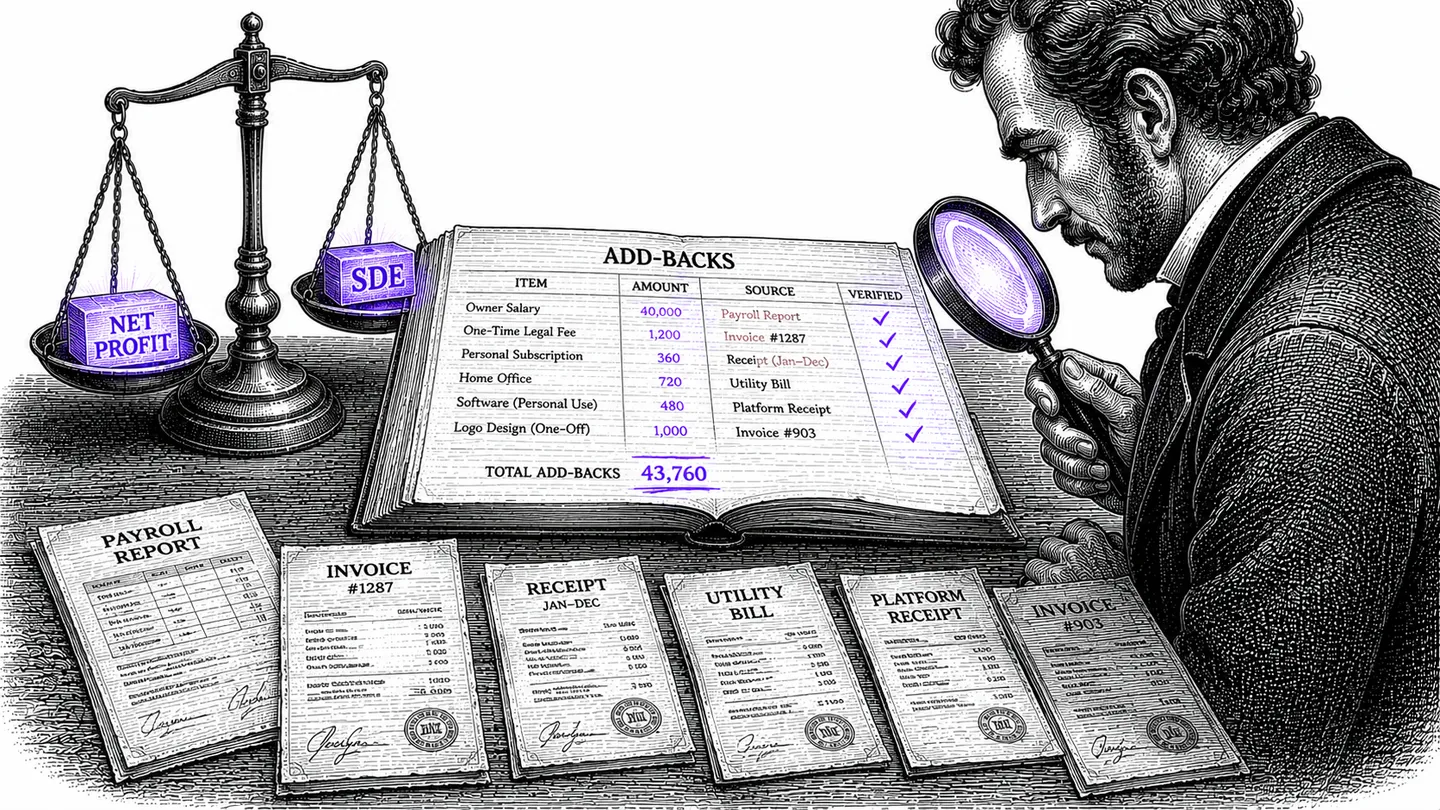
Add-backs are the most misunderstood line in a small-business valuation. Here is what an SDE add-back really is, which ones buyers accept, …