Price Your Project as a Range, Not a Number. Here's How.

In short
A single asking price starts a tug-of-war. A defensible range starts a better conversation. Here's how to build one.
You finish building something. It makes a bit of money. You decide to sell. And then you hit the question that stops most people cold: what do you ask for it?
So you do what everyone does. You find a rule of thumb online, multiply your revenue by some number a stranger on Reddit swears by, and arrive at a figure. Let's say $42,000. You put it on the listing. It looks confident. It looks decided.
It is also the weakest thing you could possibly do, and an experienced buyer can hear that within about thirty seconds of opening the conversation.
Here's the problem with a single number. It has no anchor. You can't explain how you got to $42,000 instead of $38,000 or $50,000, because you didn't reason your way there. You picked it. And the moment a buyer senses there's no method underneath the figure, the only conversation left is whether the number should be lower. That's the negotiation now. Not "is this a good asset", but "how far down can I push this person who clearly guessed." You've handed the buyer the whole frame, and the frame is a tug-of-war you're going to lose.
The fix is to stop quoting a number at all. Quote a range, and show the reasoning underneath it. This is how experienced operators have always priced, they just don't usually write it down. So here it is, written down.
Why the single number fails before the first message
A price is a claim. When you list at $42,000, you are claiming the asset is worth $42,000, and a serious buyer will immediately ask the only question that matters: based on what?
If you can't answer, you've revealed that the number is hope wearing a suit. The buyer now knows two things. First, you haven't done the work. Second, you'll probably fold when pushed, because people defend positions they've reasoned through and abandon positions they invented. The single number is an invitation to discount, and buyers accept that invitation every time.
A range does the opposite, and the trick of it is that the thing which looks like openness is also what protects you. "$32k to $38k, here's how I got there" feels like you're showing your hand, but it puts you on firmer ground than the lone figure ever could. You're no longer defending a price you can't justify. You're presenting a method, and the buyer who wants to argue now has to argue with the inputs rather than your nerve. That's a different conversation, and it's the one that actually closes deals.
The rest of this is how to build the range. Three inputs, six steps. Each one is something you can document, which is the point: the work of building the range is the same work as writing a listing a buyer can trust.
The three inputs that build a range
A defensible range comes from three things, and only three.
The first is comparable sales. What did similar projects actually transfer for in the last twelve months? This is your starting picture of the world before you've looked closely at your own asset. Call it the prior view.
The second is your project's own metrics. Recurring revenue or one-off, churn, traffic mix, how long it's been trading, how much of it depends on you personally. This is the evidence that moves you up or down from that starting picture.
The third is your floor. The price below which you would genuinely rather not sell. Not the lowest you'd ever accept in a tense negotiation, but the line where keeping the asset beats letting it go.
Comparables tell you where the market sits. Your metrics tell you where you sit inside it. Your floor tells you when to walk. Put them together and you have a range with the reasoning visible. Here's how to build each input in order.
Step one: build the prior
Pull five to ten comparable sales from the last twelve months. Same category, same revenue model, roughly the same size. A small content site is comparable to other small content sites, not to a SaaS on the same revenue with very different margins and churn.
You can source these from public deal data. Marketplaces that publish sold listings and asking prices give you a rough picture of what has transferred recently, and Indiemaker's own listings show you what comparable assets are priced at right now. None of these is a perfect match for your asset, and that's fine. You're not looking for one number. You're looking for the shape of the market.
What you'll find is a spread. Measured as a multiple of annual profit, the gap between the cheapest and the dearest comparable in a category is often wide – a content site might transfer anywhere from around 2 to 3× annual profit depending on its quality and durability, with a clean, durable one commanding the top of that band while a fragile, single-channel one sits at the bottom on identical revenue. That spread is not noise to be averaged away. The spread is your prior. Write down the low end and the high end. Resist the urge to collapse them into a tidy average, because the average is a fiction that hides the most useful information you have: the market pays very different prices for the same category depending on quality, and your job in the next step is to work out which end of that you're on.
Step two: locate your project inside the range
Now go comparable by comparable and ask, honestly, where your project sits relative to each one. For every comp, write two or three reasons yours is stronger or weaker.
Recurring revenue moves you up. One-off or project-based revenue moves you down. Organic traffic moves you up; paid acquisition you can't easily hand over moves you down. A diversified traffic base moves you up; 80% from a single Google keyword moves you down, hard. Eighteen months of steady trading moves you up. Being a one-person operation where you are the brand, the support desk and the growth engine moves you down, because the buyer is acquiring a job as much as an asset.
The discipline here is to move on documented facts, not hopes. "My churn is low" is a hope. "My churn has averaged 4% a month over the last year, here's the Stripe export" is a fact. Move up or down the comp range only on the things you can show. If you can't evidence it, it doesn't move the price, however true you believe it to be. This is also a useful preview of the diligence conversation, because every adjustment you make here is something a buyer will test later. Better to find the weak ones now.
Step three: set the floor and the ceiling
This is the step most sellers rush, and it's the one that does the most work.
Your floor is the price below which you'd rather keep the asset than sell it. It is a decision about whether to transact at all, not a negotiating tactic. Work it out properly. What does the project earn you in a year of doing nothing new to it? What would you do with the proceeds, and is that better than another year of ownership? If the asset clears $1,400 a month on near-zero effort, a $20,000 offer is roughly fourteen months of passive income handed over in one go, and you may decide that's a poor trade. That calculation is your floor. It has nothing to do with what the buyer thinks and everything to do with what you'd actually accept on a quiet Tuesday with no pressure.
The ceiling is the opposite failure. It's the price at which you stop sounding confident and start sounding deluded, and serious buyers quietly leave. Every category has a level where the multiple is so far above the comparables that experienced operators read it as a seller who hasn't done the work, or won't negotiate, and they don't bother opening the conversation. Your ceiling is the top of your comp range, adjusted up only by the genuine strengths you documented in step two. No further.
Your asking range sits between those two, not at either end. Publish it as a range with the reasoning underneath. "$32k to $38k, rationale below." Then put the rationale there: the comps, the adjustments, the floor logic in plain terms. A buyer reading that is no longer wondering whether you guessed. They can see that you didn't.
A quick word on the floor, because it's where nerves take over. Telling a buyer your floor feels like surrender, so most sellers hide it and let the buyer fish for it instead. That's backwards. A seller who says "I won't go below $30k, and here's why that's a fair line, not a stubborn one" reads as someone who knows their asset. A seller who dodges the question reads as someone still working out what they'll accept, which tells the buyer to keep pushing. Sharing your floor first, with a reason attached, is a credibility move. It ends the fishing and starts the real negotiation.
A worked example
Take a small SaaS earning $1,000 a month in profit – $12,000 a year – in a narrow vertical. Here's the range, built input by input.
| Step | Input | Effect on price |
|---|---|---|
| Prior | Comparable small SaaS sales, last 12 months | 3–4× annual profit → $36,000–$48,000 |
| Adjust down | 4% monthly churn | Below the comp band's low end |
| Adjust down | Single-founder dependency (you are support + growth) | Further down – the buyer inherits a job |
| Adjust up | 18 months of steady trading history | Recovers a little |
| Floor | Below this you'd rather keep it | $30,000 |
| Asking range | Published with rationale | $32k–$38k |
Illustrative figures. The method is the point, not the numbers, which will differ for every asset.
Notice what the table does. It doesn't produce one price. It produces a defensible band, and every line is something the buyer can interrogate and you can stand behind. The seller who lists "$38,000" and the seller who lists "$32k to $38k, here's the working" are quoting overlapping numbers, but they are not in the same negotiation. One is defending a guess. The other is presenting a case.
What this actually changes in the conversation
Here is the shift, and it's the whole reason to do any of this.
When you price as a single number, the buyer argues about the number. Up or down, that's the only axis. And because you can't defend the figure, you lose ground every time the question gets asked.
When you price as a defensible range, the buyer argues about the inputs. Are the comps right? Is the churn adjustment fair? Is the single-founder risk really worth that much of a discount? Those are real questions, and here's the thing: you know the answers better than the buyer does, because you built the range and they're seeing it for the first time. You've moved the negotiation onto ground where you hold the information advantage. Openness bought you that advantage. The seller who hides the working never gets there.
This is why a defensible range often beats a higher single number outright. The higher number triggers the discount reflex and you spend the whole deal retreating. The range triggers a discussion about evidence, and a seller who's done the evidence wins that discussion most of the time.
It also makes you a better seller of the asset generally. The comps you pulled, the metrics you documented, the risks you named honestly: that's most of a strong listing already. Pricing as a range forces you to do the work that makes the whole sale easier. If you want the deal mechanics that follow, how the money actually moves in a safe transfer and the 14-day handover prep pick up where the price leaves off.
This is the kind of thinking the platform is built around. Indiemaker exists to make small digital exits behave like real transactions rather than guesswork, and a price you can defend is where that starts. It's the same instinct behind valuing an asset with platform risk in the multiple and knowing what actually makes a project transferable: the number is downstream of the work, and the work is what a buyer is really paying for.
So before you publish a figure, ask what happens when a buyer asks how you got there. If the honest answer is "I multiplied something by something", you haven't set a price. You've set a target for someone else to shoot at. Build the range instead, show your working, and let the buyer argue with your evidence rather than your nerve. The seller who can defend a range has already done more than the seller who can't, and at this end of the market, the work is the asset.
More on pricing
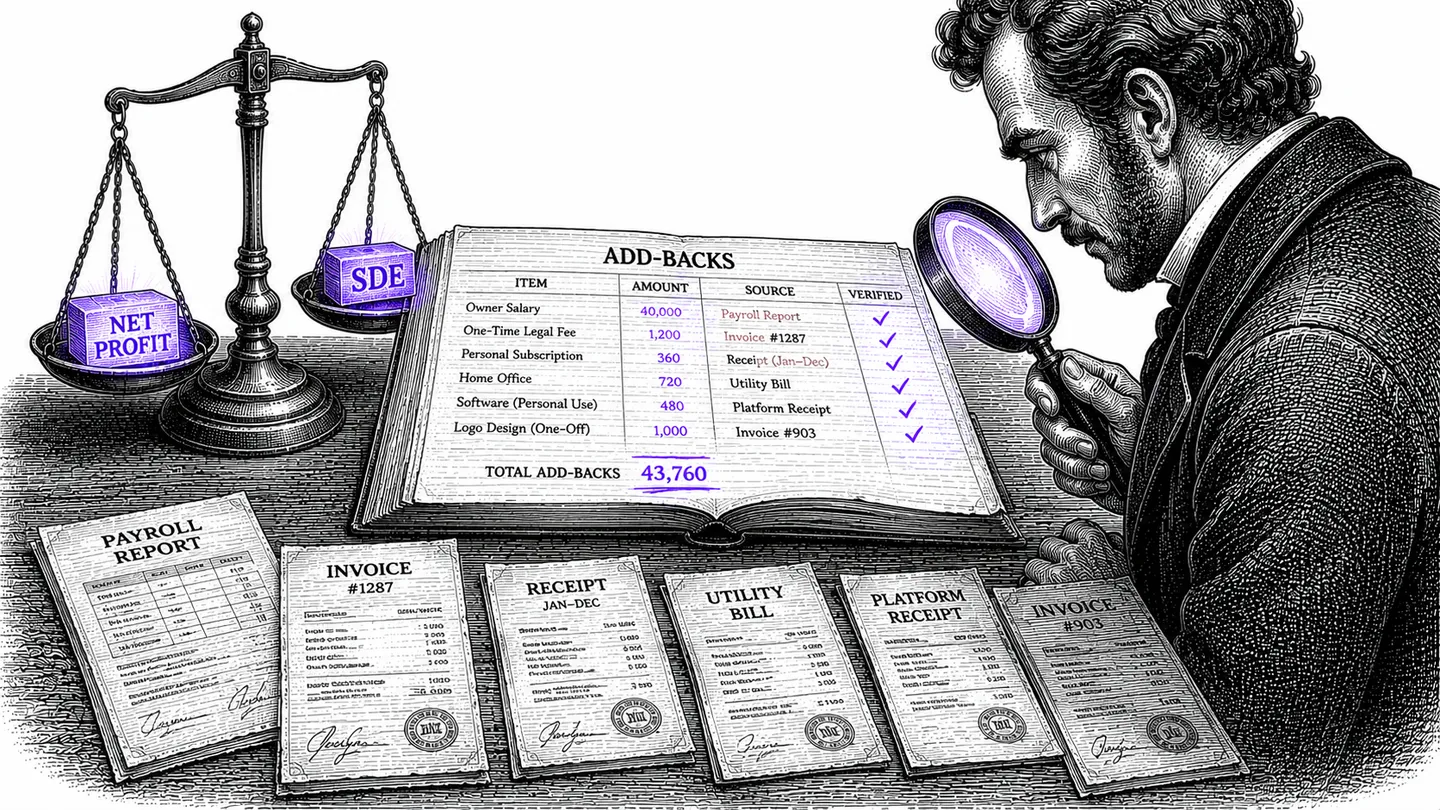
Add-backs are the most misunderstood line in a small-business valuation. Here is what an SDE add-back really is, which ones buyers accept, …

The multiple isn't the answer. Durable profit is. Here's how to price an asset when the foundation is borrowed.
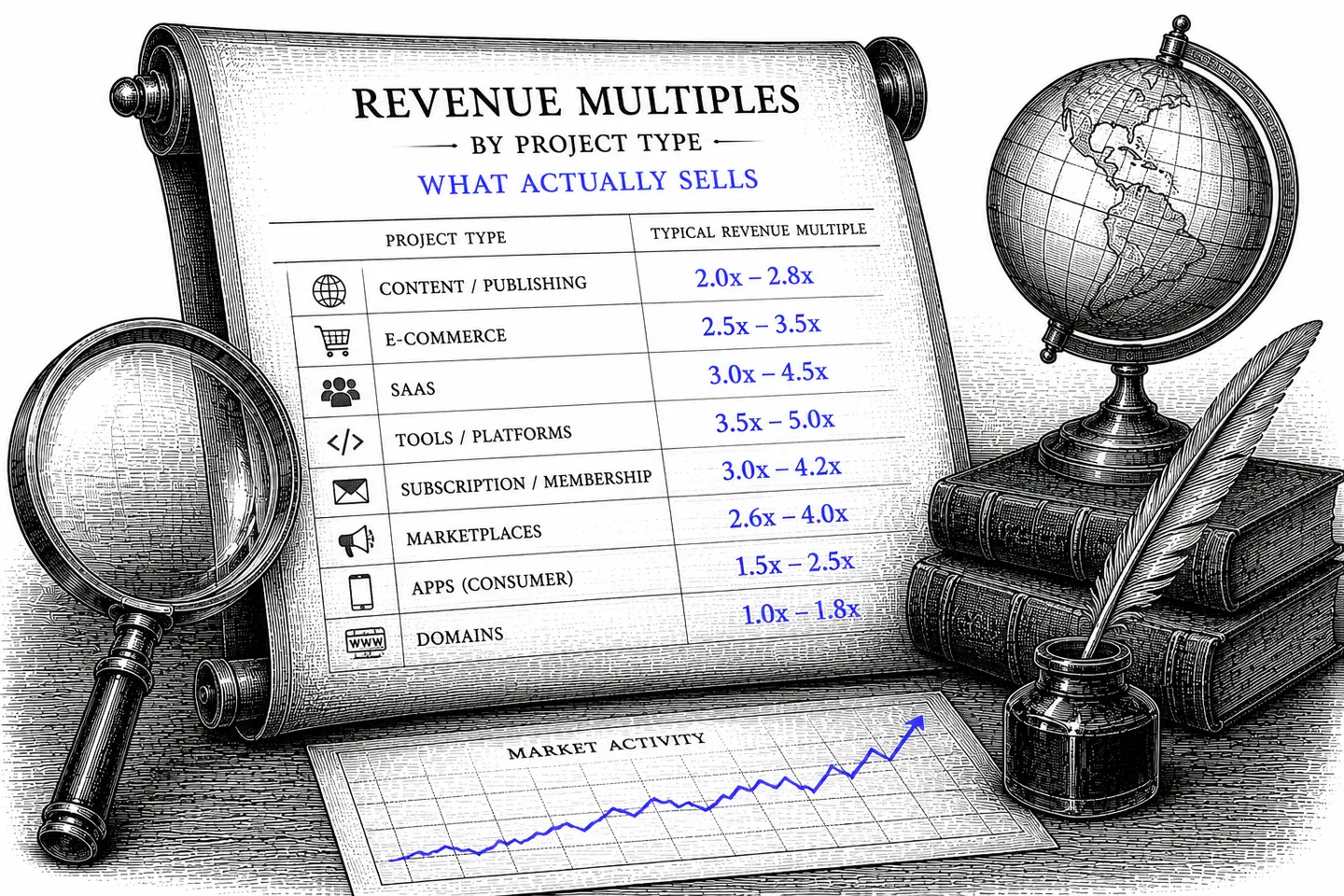
Use a 2 to 4x multiple" is incomplete advice. The right range depends on type, consistency, and transferability. Here's the actual table.