Revenue Multiples for Small Digital Businesses: What Actually Sells and At What Price
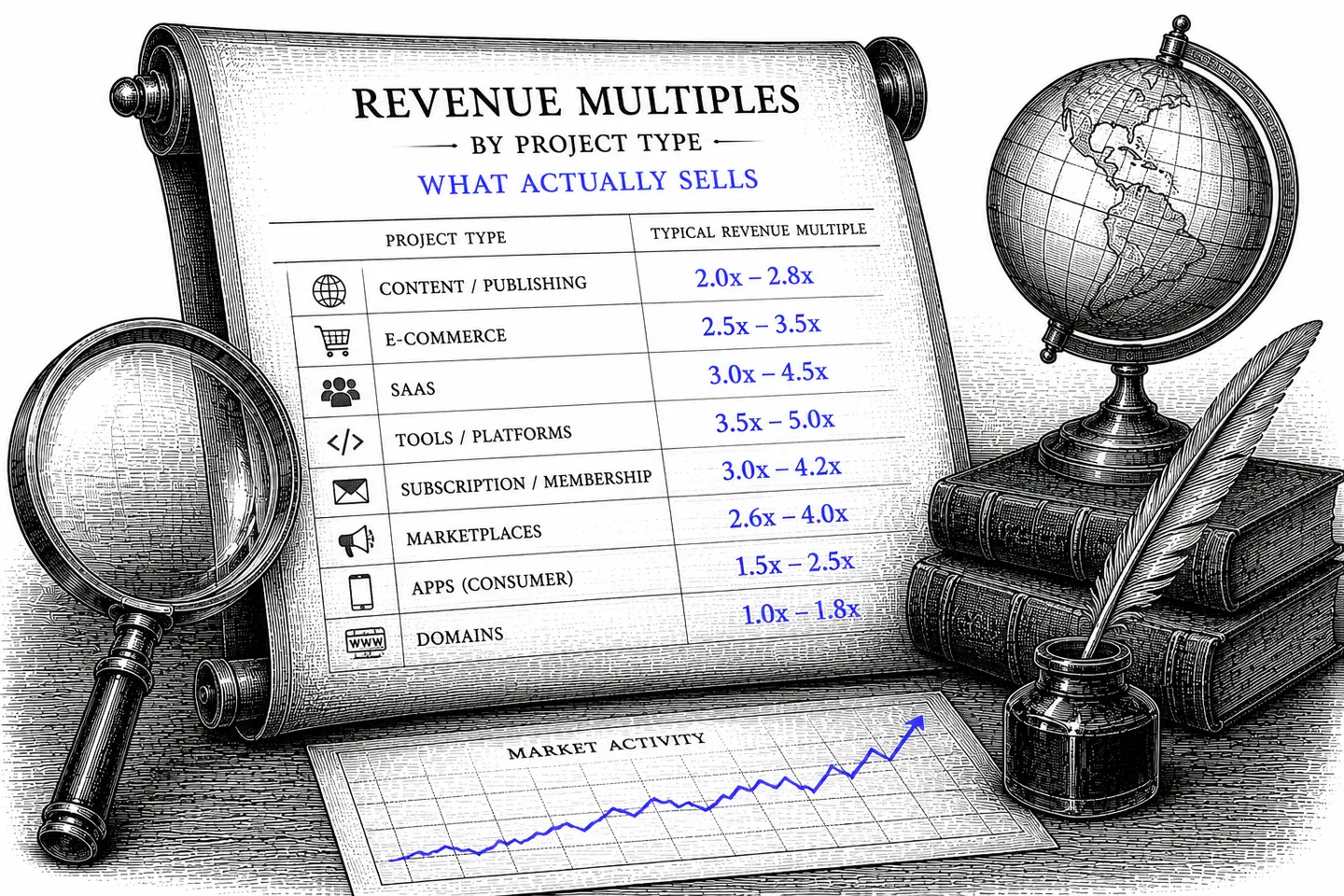
In short
Use a 2 to 4x multiple" is incomplete advice. The right range depends on type, consistency, and transferability. Here's the actual table.
"Use a 2 to 4x multiple."
That is the standard advice, and it explains nothing. The range exists. What determines where inside the range you land? The person offering the advice rarely says, and the person acting on it usually picks the wrong end.
The multiple you can honestly ask for depends on three things: the type of asset you are selling, how predictable its profit is, and how much work the buyer has to do to keep the number where it is. Miss any of those variables and the wrong multiple either kills a live deal or leaves a lot of money in the buyer's pocket. Get them right and the multiple is not a negotiation. It's a description.
This is what the actual ranges look like, category by category, and what moves the needle inside each one. A note on the base before the table: every multiple below is on trailing annual profit, not revenue and not a monthly figure. A business earning $500 a month of profit is being valued against its year, roughly $6,000, not its month.
The multiple ranges by project type
| Project type | Typical multiple (× annual profit) | Top of the range needs | Bottom of the range trigger |
|---|---|---|---|
| Micro-SaaS (recurring) | 2 to 4x | Sub-5% monthly churn, 12+ months of history, clean handover | High churn, single-founder support, custom infrastructure |
| Content site (blog, info property) | 1.5 to 3x | Diversified traffic, evergreen content, low update burden | Single-keyword dependency, downward traffic curve |
| Tools and utilities (one-off) | 1 to 2x | No support overhead, no active roadmap need | Ongoing platform maintenance, dependency on paid ads |
| Newsletter (paid or ad-supported) | 2 to 4x | High open rates, monetised list, low churn | Founder personality drives opens, single sponsor |
| Small marketplace | 2 to 3x | Two-sided liquidity, low churn on both sides | Single side of the market driving the whole thing |
The table is deliberately narrower than the internet's advice. That's because most sub-$50k deals settle inside these ranges, and the outliers – the 8x-plus SaaS multiples you see in tweets about $10M businesses – don't apply to a project earning $500 a month. Small deals have their own physics. The multiples run lower because the buyers are operators, not investors, and operators have limited capacity to absorb risk. The top of each band is real but rare: it is what a clean, transferable, predictable asset earns, not a starting position.
What earns you the top of the range
The top half of any of these ranges is not a default. It is a reward. Buyers pay it when they can see, without having to argue with you, that the project has three things:
A documented handover. The buyer can run this without you inside a week. The passwords are in a manager, the accounts are in the business's name, the runbook is a real document, the third-party services are listed.
A consistent profit curve. Twelve months, or better, of predictable earnings. Not necessarily growing. Predictable is more valuable than gently up-and-down growth in this market. Buyers pay for the ability to model next month's payout from this month's numbers, which is the same thing as pricing the asset as a defensible range rather than a hopeful number.
Minimal founder dependency. The founder's face is not on the landing page. Customers do not email the founder by name. The support voice is a company voice. When the founder disappears for a fortnight, nothing breaks.
Each of these earns you roughly a third of the distance between the middle and the top of the range. All three together – and you're in the top half. Two out of three – middle. One out of three – you're closer to the bottom than you'd like, no matter how good the raw revenue looks.
What earns you the bottom of the range (or below it)
The reverse list is short and unforgiving.
A single revenue spike sitting on top of an otherwise thin history. Buyers discount to the trailing average, not the peak, and they discount further because they now don't trust the seller's judgement about what "the business" earns.
Single-channel traffic. If ninety percent of the visits come from one search keyword, one app store, or one platform, the buyer is looking at concentration risk and pricing it aggressively. This alone can drop a SaaS multiple from 4x toward 2x, which is most of the reason a buyer walks away from a number that looked fine on the listing.
Founder-in-the-critical-path support. If half the customer base is loyal to a person rather than a product, the acquisition is not really the acquisition of the product. It's an offer to inherit a hard problem, and it prices that way. This is also the line between a business that is listed and one that is genuinely sellable.
Platform dependency. Built on someone else's API, using someone else's app store, running inside someone else's ecosystem, without a plan for what happens when the platform updates its terms. Buyers know how these stories end.
Any two of the above and you should be honest with yourself about where in the range you are asking to land.
Why "multiple" is the wrong word to fixate on
The multiple is the output of a real question, not the input to it.
The real question is: what will a buyer pay for a defined level of certainty in a defined level of return? A buyer paying 4x for a $500-a-month SaaS is not paying 4x because of the number. They are paying because they can model $500 a month for the next eighteen months with reasonable confidence, and the whole transfer will cost them two weekends of effort.
A seller who reframes their listing around certainty rather than around the multiple gets better offers. The certainty is what the buyer is actually shopping for. The multiple falls out of the answer.
The category most consistently priced wrong
If you spend enough time in the sub-$50k end of the market, one category stands out for how consistently it is mispriced in both directions.
Tools and utilities. Small, focused, one-off-purchase products that solve a real problem and do not need active development. They look boring on paper. They earn a modest multiple. And they are the closest thing to a free lunch a small buyer can find, because they require almost no maintenance to keep earning.
Sellers routinely undervalue these because the revenue looks unspectacular and the growth curve is flat. Buyers who understand the category will pay closer to the top of the range for one, because they are not buying a growth story. They are buying a Tuesday morning where nothing is on fire. Sellers who realise this before listing capture a real premium. Most don't.
The newsletter exception
Newsletters used to sit in the "content site" range. They are drifting toward the SaaS range, and quickly.
A newsletter with high open rates, a monetised list, and a durable audience relationship is now selling at 2.5 to 4 times annual profit in a way that would have been unthinkable three years ago. The reason is simple: attention is now the scarce input, and the newsletter is one of the few remaining formats where attention is owned by the operator, not rented from a platform. Buyers are catching up to this. Sellers, mostly, aren't. There's still price arbitrage available at this end of the market.
The exception has an important footnote: newsletters where the founder is the personality. Those look valuable and are almost impossible to transfer. The buyer inherits the list and loses the reason people opened the emails. If the personality is the product, price accordingly. If the newsletter is a brand rather than a person, the SaaS-adjacent multiple is available.
How to position your project inside the range before listing
The pre-listing checklist is not glamorous.
Get the profit history exportable and clean. Move accounts into the business's name. Document the handover in one honest, complete file. Diversify the traffic if you can, and if you can't, name the concentration risk plainly. Most of this is the same work as assembling the pre-listing data pack a serious buyer asks for in the first exchange.
Every one of those actions moves you closer to the top of the range for your category. None of them will make a bad business look good. All of them will make a real business look priceable.
The one-line version
The multiple is not what the buyer is paying for. It is the price they arrive at after answering three questions you haven't asked yet: what does this reliably earn, how much work is it to run, and how confident can I be in the number twelve months from now.
Sell the answers to those three questions well and the multiple takes care of itself.
Indiemaker's listings settle inside the ranges above because sub-$50k buyers are running the same maths, whether they say it out loud or not. Sellers who arrive knowing where they sit close in weeks. Sellers who arrive with a number lifted from a Twitter thread relist at Christmas.
More on pricing

A single asking price starts a tug-of-war. A defensible range starts a better conversation. Here's how to build one.
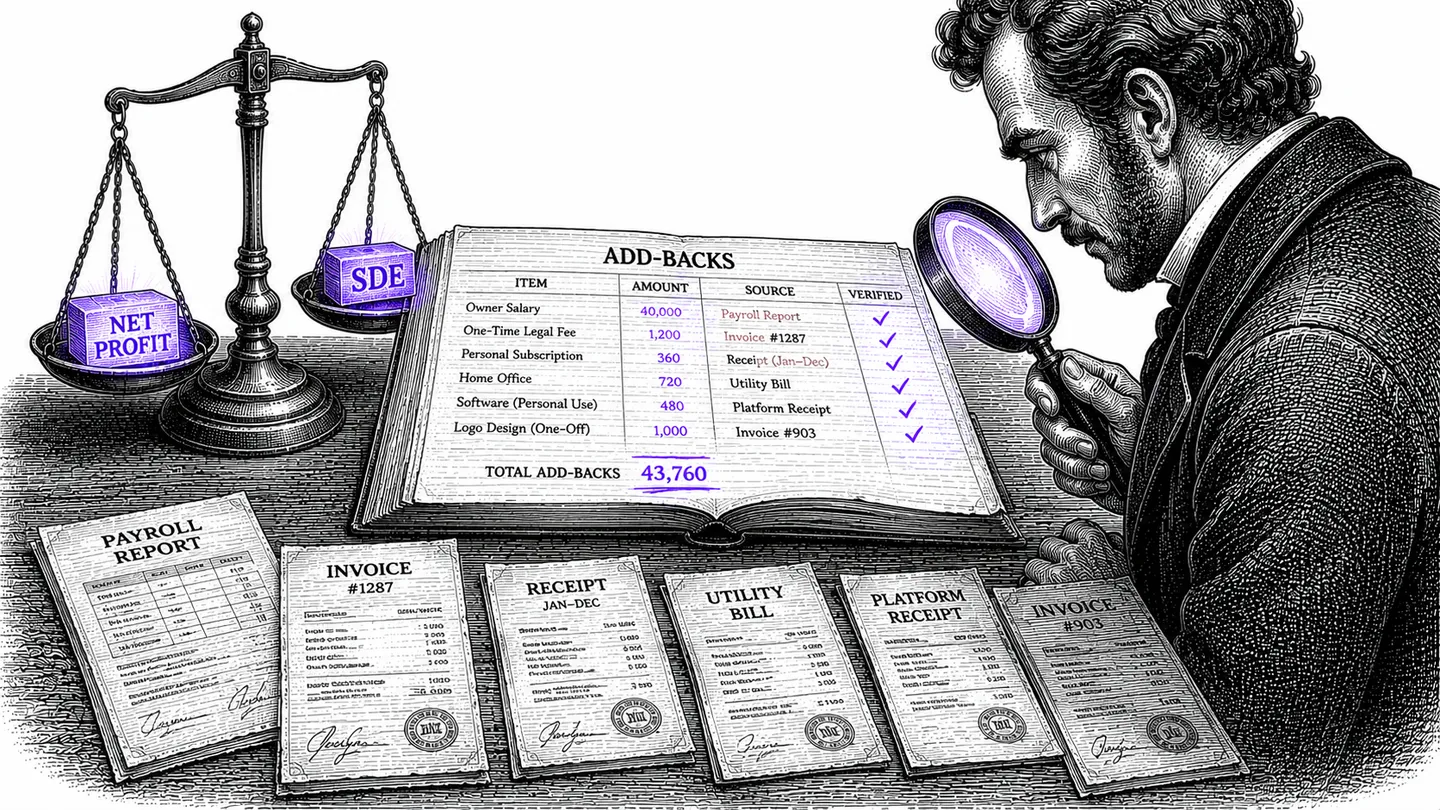
Add-backs are the most misunderstood line in a small-business valuation. Here is what an SDE add-back really is, which ones buyers accept, …

The multiple isn't the answer. Durable profit is. Here's how to price an asset when the foundation is borrowed.