What add-backs actually mean, and how buyers verify them
In short
Add-backs are the most misunderstood line in a small-business valuation. Here is what an SDE add-back really is, which ones buyers accept, which they contest, and which quietly kill a deal.
Add-backs are the single most misunderstood line in a small-business valuation, and they are where sellers inflate earnings and buyers get burned. In a bigger deal, one questionable adjustment gets lost in the noise. In the $1k to $150k band the entire price often turns on two or three add-back lines, so getting them honest is disproportionately important.
This piece explains what an add-back actually is, which adjustments a reasonable buyer accepts, which ones they push back on, and which ones quietly kill a deal when they surface. It is written for both sides, because the goal is the same for everyone: a final multiple that sits on numbers all parties trust.
One boundary before we start. This is about profit and the adjustments made to it. Confirming that the revenue is real in the first place is a separate job, covered in the 90-minute revenue verification session. Here we assume the top line is genuine and focus on what happens between net profit and the figure you multiply.
What an add-back actually is
Start with net profit, the figure left after the business has paid all its costs. That number is honest but it understates what the business is really worth to an owner-operator, because it includes costs that a new owner would not carry, or that are personal to the seller.
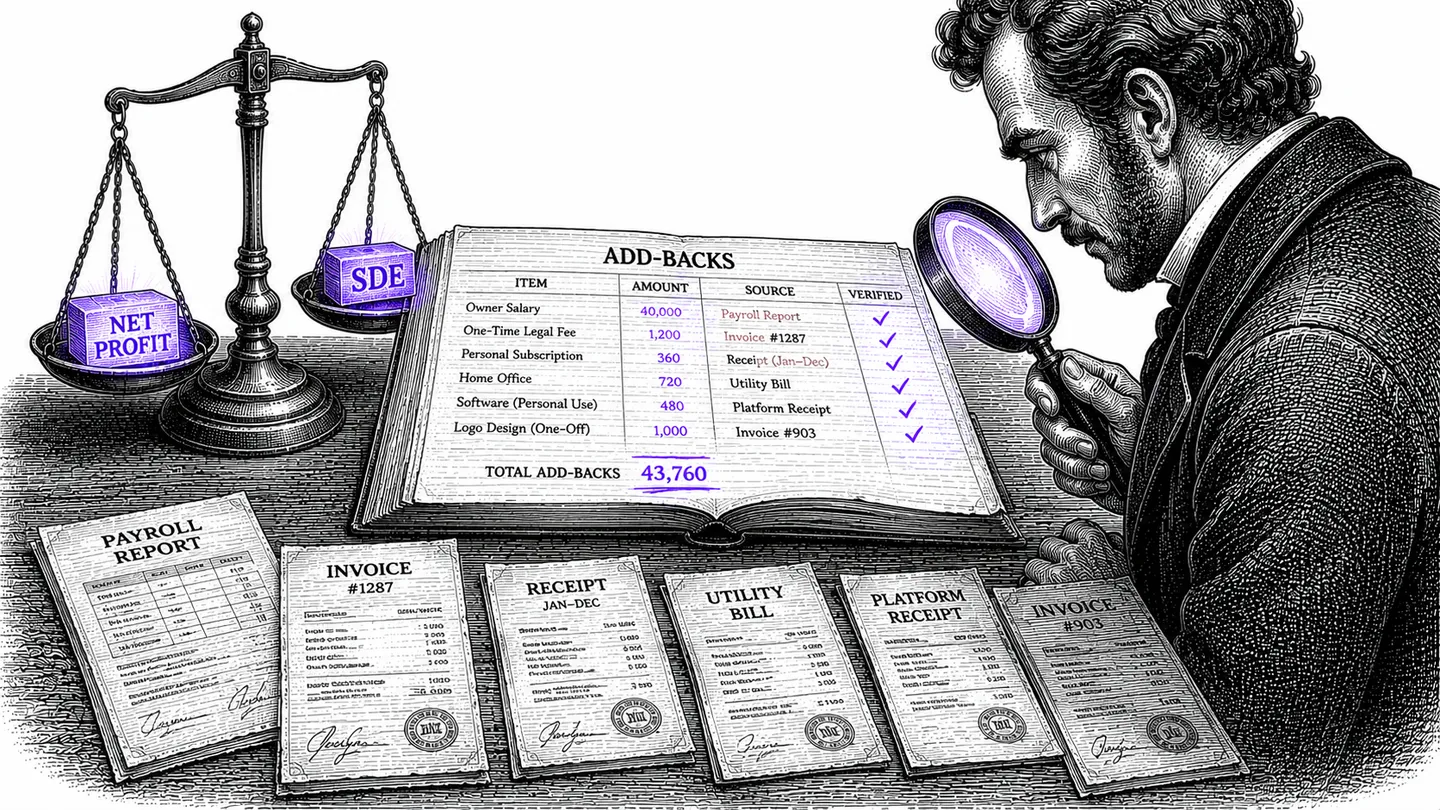
Seller's discretionary earnings, or SDE, corrects for that. SDE is net profit plus the owner's own salary, plus genuine one-off costs, plus spending that is truly discretionary or personal. Each of those additions is an add-back. The logic is that a buyer wants to see the cash the business would generate in their hands, stripped of one seller's particular choices.
That logic is sound. The trouble is that the same logic, stretched, can justify adding almost anything back. Which is why every add-back has to be defensible, not just plausible.
Why add-backs matter more on a small deal
On a business earning a few million, a $5,000 add-back is a rounding error. On a business earning $30,000 a year, a $5,000 add-back moves the profit figure by a sixth, and at a multiple of, say, three times annual trailing profit, that single line changes the price by $15,000.
That leverage cuts both ways. An honest add-back a buyer wrongly rejects costs the seller real money. A dishonest one a buyer fails to catch means overpaying by a multiple of the inflated amount. Because Indiemaker deals settle in cash or by wire with no earn-out and no deferred payment, there is no future adjustment to fix a mistake after the fact. The agreed profit figure has to be right at close. That is exactly why both sides should care about getting the schedule clean.
The add-backs buyers accept without argument
Some adjustments are so standard that a reasonable buyer waves them through, provided there is documentation.
The owner's own salary or drawings is the clearest example. If the seller paid themselves $40,000 to run the business, and you intend to run it yourself, that cost is genuinely yours to reclaim or redeploy, so it is added back. One-time costs are the next category: a company formation fee, a one-off legal bill, a logo design, a website rebuild that will not recur. These happened once and will not burden the new owner.
Personal expenses run through the business also qualify, when they are truly personal and evidenced. A phone contract, a home-office cost or a subscription the seller used for personal reasons but expensed can reasonably be added back, as long as there is a receipt showing what it was.
The common thread is evidence. An accepted add-back is one you can point at a document to justify.
The add-backs buyers will question
The next tier is where negotiation actually happens. These are not dishonest, but they need defending.
The most common is the "founder worked for free" adjustment. A seller who personally wrote every article or answered every support ticket may add back the value of that labour, arguing the business "really" earns more. The buyer's fair response is: if that work has to continue, and I will have to pay someone to do it, then it is a real cost, not an add-back. The defence is to show the work is genuinely optional or already outsourced at a known price.
Blended subscriptions are another. A software tool used half for this business and half for something else cannot be added back in full. The reasonable position is to split it by actual usage and add back only the personal share.
Then there are optimistic future savings, "once you renegotiate this contract you will save $200 a month". That may be true, but it is a projection, not trailing profit, and it does not belong in the historical figure you are pricing on. If a seller wants credit for it, it belongs in the conversation, not the schedule.
The add-backs that kill a deal
Some add-backs do not just get rejected, they poison trust in the entire schedule, because once a buyer catches one they reasonably assume there are others.
Three are fatal. First, any add-back with no documentation at all, a number that exists only because the seller says so. Second, a recurring cost dressed up as a one-off: a "one-time" expense that turns out to appear every year, which is either carelessness or misdirection. Third, and worst, revenue-generating spend removed to fake margin, for example adding back the advertising cost that actually drives the sales, which makes the business look far more profitable than it can ever be without that spend.
When one of these surfaces, the sensible buyer does not just strike the line. They re-examine every other add-back with fresh suspicion, and the deal often stalls there.
How an experienced buyer verifies each add-back
Verification has one rule: trace every line to source, never to the seller's own spreadsheet. The spreadsheet is the claim you are testing, not the evidence.
For each add-back, the buyer asks for the underlying document. An owner salary should trace to payroll records or drawings in the bank statements. A one-off legal cost should trace to the invoice, dated, so you can confirm it happened once. A personal subscription should trace to the platform receipt showing what it was. A blended cost should be supported by usage data that justifies the split.
The practical method is to sit with the bank statements and the profit figure side by side and walk each add-back back to a real transaction. Anything that cannot be traced comes out of the figure until it can be. This sits inside the wider diligence process covered in due diligence for sub-$500k digital deals, and it is worth the hour it takes.
How to present your add-backs honestly as a seller
If you are selling, the fastest way to a clean deal is to make verification easy. Build a dated add-back schedule with one source document per line, before the buyer asks. List each adjustment, its amount, the reason it qualifies, and a link or reference to the receipt, invoice or statement that proves it.
This does two things. It speeds the deal, because the buyer can verify in an afternoon instead of a fortnight of back-and-forth. And it builds trust, because a seller who has already sourced every line reads as someone with nothing to hide. Leave out anything you cannot document. A slightly lower, fully defensible profit figure closes far more reliably than an inflated one that collapses under scrutiny.
Turning a clean add-back schedule into a defensible multiple
Add-backs are not an accounting footnote. They feed directly into the annual trailing profit figure, and that figure is what the multiple is applied to. As rough bands, content businesses tend to trade around 1.5 to 3 times annual trailing profit and micro-SaaS around 2 to 4 times, always conservatively, but the multiple is only as sound as the profit beneath it.
Which means an inflated add-back is really an inflated price, multiplied. Get the schedule honest and every downstream number follows. For how those multiples are set once the profit is clean, see how to value a small digital business and revenue multiples by project type.
A clean add-back schedule is the least glamorous part of a deal and the one that most reliably determines whether the price is fair. Spend your effort there, on both sides, and the multiple takes care of itself.
More on pricing

A single asking price starts a tug-of-war. A defensible range starts a better conversation. Here's how to build one.

The multiple isn't the answer. Durable profit is. Here's how to price an asset when the foundation is borrowed.
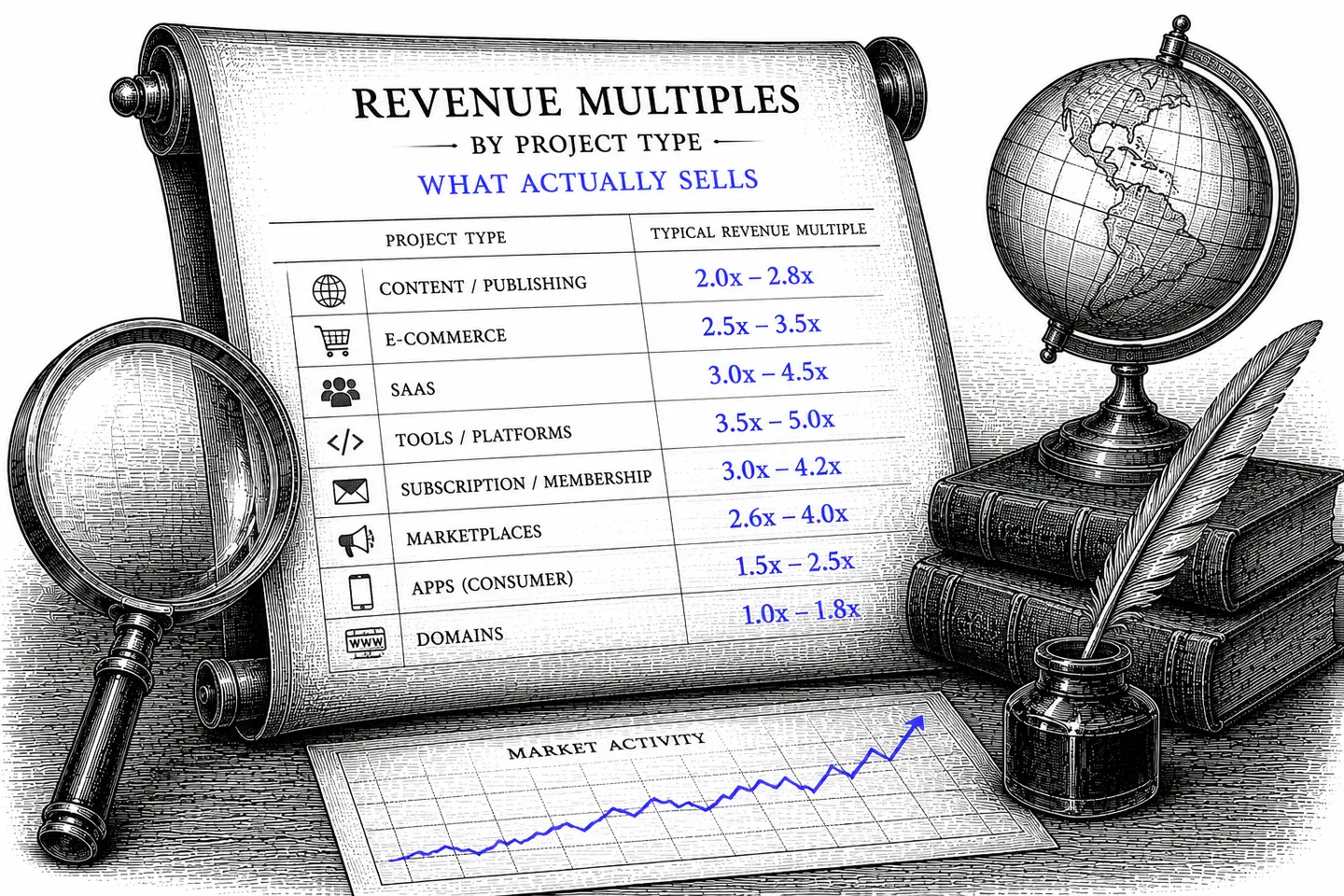
Use a 2 to 4x multiple" is incomplete advice. The right range depends on type, consistency, and transferability. Here's the actual table.