How to Value a Small Digital Business (Without a Broker)
In short
Most valuation guides are written for companies ten times your size. Here's how the maths actually works below $100K.
Most valuation guides are written for companies doing $1M+ in annual recurring revenue. If you're reading those guides and trying to apply them to the $800/month SaaS tool you've been running for two years, you're doing the equivalent of using an HGV manual to pass your driving test.
Below $100K, the maths works differently. The frameworks are different. The comparables are different. The buyer psychology is different. And the mistakes sellers make are different, too – usually in one direction: they either over-price on vanity metrics, or they under-price because they've lost confidence in what they built.
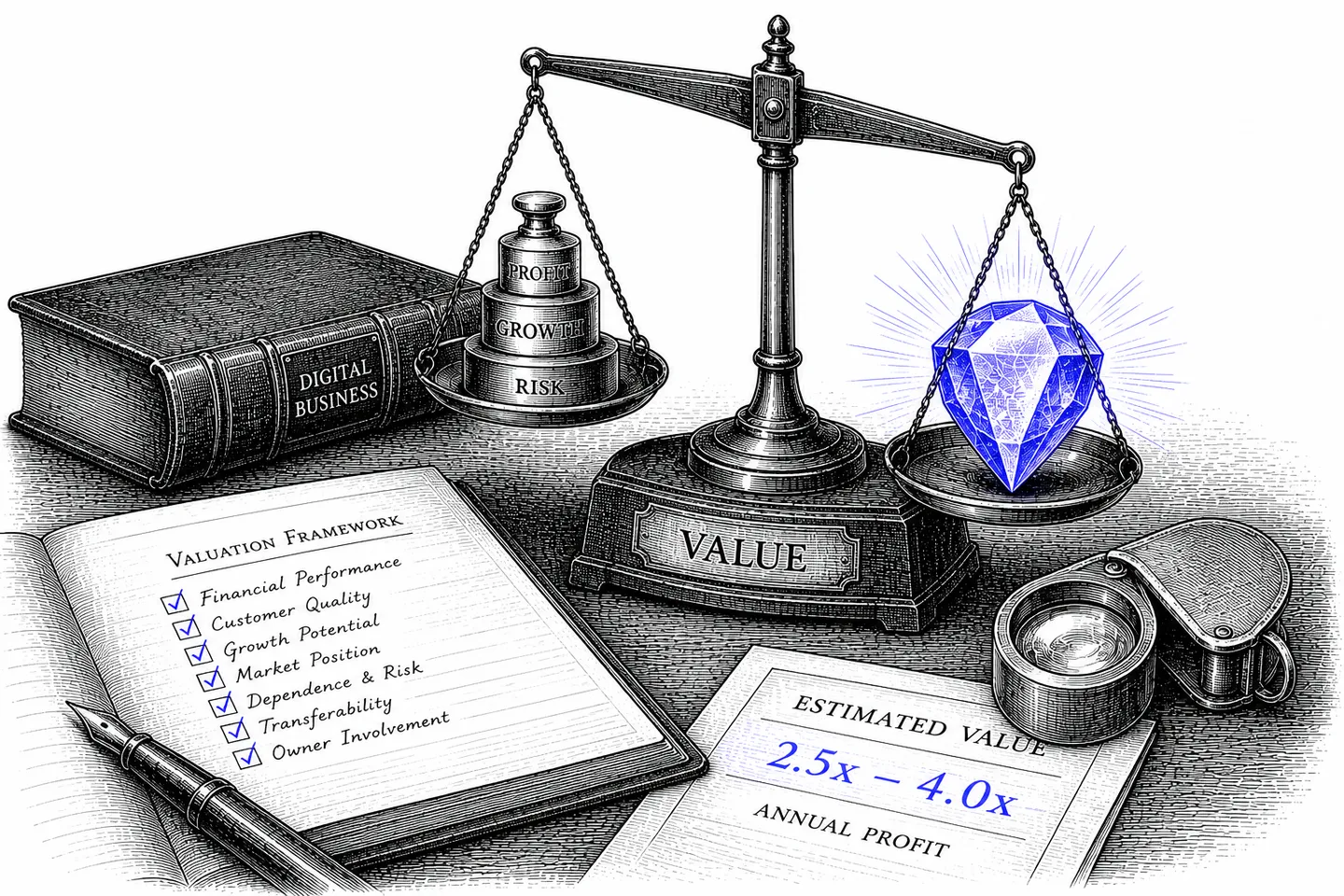
Strip it to the core and it's simple: you price seller discretionary earnings – annual net profit before your own time is added back – at roughly 2–5× depending on the asset type, not revenue. Everything below is how to land that number and defend it.
Why don't standard valuation multiples work under $100K?
When a broker or investor talks about "multiples," they're usually talking about revenue multiples: a company doing $500K in ARR might trade at 4× revenue, valuing it at $2M. That framework makes sense when you have predictable, recurring revenue at scale and a business that operates independently of any individual.
Below $100K, buyers aren't paying for scale. They're paying for a working, transferable product with a defensible profit margin and a believable future. The metric that matters is seller discretionary earnings (SDE) – roughly, the net profit the business generates after operating costs, calculated before the owner's salary or time cost is factored back in. It's the number that tells a buyer: "If you ran this thing, here's what you'd take home."
Revenue multiples underweight profitable small products and overweight loss-making ones. SDE multiples cut through that. They price the actual economics, not the top line.
So the first move in valuing a small digital business is to stop asking "what's my revenue?" and start asking "what does this thing actually make?"
Which three numbers set your asking price?
1. Monthly net profit (and how consistent it is)
Take your average monthly revenue over the last 12 months, subtract your actual operating costs – hosting, tools, subscriptions, contractor time, support costs – and you have your monthly net profit. A product making $600/month in profit after costs is worth significantly more than a product making $1,200/month in revenue with $700 in costs, even though the revenue looks more impressive.
Consistency matters as much as the number itself. A product that has made $500–$600/month for 18 consecutive months is worth more than one that made $1,500 last month and $200 the month before. Buyers are underwriting future income, and variance is risk. Smooth income commands a higher multiple. Erratic income gets priced at a discount.
A rough worked example: a tool generating $400/month in net profit – about $4,800 a year – consistently, over 12 months. At a 2.5× annual profit multiple, the asking price is $12,000. At 3×, it's $14,400. That range, roughly 2.5–3.5× annual profit for a stable, low-maintenance product, is broadly where straightforward micro-SaaS and tool-type assets trade on the current market.
2. Owner time commitment
How many hours per week do you actually spend on this? Be honest. "Two hours a week" sounds good; "twenty hours a week" does not – not because it's wrong to put in the work, but because a buyer is buying the income stream, not the job. The more owner-dependent the product is, the lower the multiple it commands.
A product that runs on cron jobs and Stripe webhooks with a support ticket once a fortnight is worth more than a technically similar product that requires the owner's attention daily. The former is an asset. The latter is employment with extra steps.
This is the part sellers consistently underestimate in the opposite direction. If you've spent two years making something that genuinely doesn't need you, that's worth communicating clearly in the listing. It compresses buyer risk and directly increases what someone will pay.
3. Transferability
Can a new owner actually take this over? Not in theory – in practice. Does it use a dedicated business email or your personal Gmail? Is the payment processor account in a business name or tied to your identity? Is there documentation for anything beyond the obvious?
Transferability is often worth more in a multiple negotiation than a few extra hundred dollars in monthly profit. Buyers aren't just paying for what a project earns – they're paying for confidence that the handover won't be a disaster. A product with clean accounts, clear documentation, and no identity-locked dependencies removes that risk. That's real value.
What drags your multiple down
The gaps between what a seller thinks their product is worth and what a buyer will pay usually come down to a handful of structural issues. Most of them are fixable before listing.
Single-channel dependency. If 80% of your traffic comes from one Google keyword, or your entire revenue is from two clients, buyers will discount this as risk. Diversified traffic and revenue signals resilience. Single-channel concentration signals a cliff edge.
Undocumented revenue. Stripe data is verifiable. Screenshots of PayPal are not. Buyers doing any kind of due diligence will ask for connected revenue verification, and sellers who can't provide it lose credibility and negotiating leverage fast. If you want to support your asking price, get your revenue history into a format that can be independently verified.
Ghost traffic. High traffic numbers with low revenue or low engagement tell a story buyers don't like. Traffic from spam referrals, outdated SEO, or one viral post two years ago is worth very little. Traffic that converts – into subscribers, paying customers, or returning users – is worth a great deal. Know which you have.
Non-transferable customer relationships. If customers are buying because of you – your reputation, your personal follow, your consultancy relationship with them – then a new owner inherits the product but not the reason people pay. This isn't fatal, but it needs to be honestly acknowledged and priced accordingly.
How to sanity-check your price against real comparables
You don't need a broker to find comparable sales data. There's a working market for micro-acquisitions with publicly visible transactions, and that data tells you more than any formula.
Different digital asset categories trade in meaningfully different multiple ranges:
- Content sites and newsletters have typically traded at 2–3× annual profit, though those multiples have compressed over the past 18 months as Google's AI Overviews have eroded search-dependent traffic and made content sites harder to underwrite with confidence. A newsletter with clean, direct email traffic and verified subscriber engagement sits toward the upper end; an ad-dependent content site with Google dependency sits toward the lower – and buyers know the difference.
- Micro-SaaS and tools generally trade at 3–5× annual profit for solid products with low churn and low owner time. The range is wide because the product quality variable is wide.
- Automations and workflow tools vary significantly depending on how owner-dependent they are and whether the underlying platform (Zapier, Make, Notion) has stable API terms. High variance in this category; price accordingly.
- Mobile apps and browser extensions depend heavily on platform risk – App Store policy changes, Chrome Web Store policy shifts, and whether the download curve is still growing or in slow decline.
Position your product honestly within these ranges before you settle on a number. If you're pricing at the top of the range, know what justifies that – and be ready to evidence it.
Indiemaker has processed enough listings to see which categories attract serious buyer interest and which sit unsold at inflated prices. The gap isn't usually between asking price and market price. It's between what the seller thinks their product represents and what the buyer can verify it represents.
The mistakes that kill deals before they start
Pricing on vanity metrics. "We have 10,000 users" means nothing without revenue context. "We have $150K in pipeline" from a product making $300/month in actual revenue means nothing. Buyers pay for what a business does, not what it could do. Aspirational valuations don't close.
Underpricing out of imposter syndrome. The opposite problem, and arguably more common among solo founders who've been building quietly for two years. If your product has consistent net profit, clean documentation, and transferable infrastructure, it is worth more than you feel it is. There's a reason Indiemaker sets a minimum listing price of $1,000 – below that threshold, the economics of a proper handover don't work for either side. The floor exists because transfers at very low prices almost never justify the time they take.
Listing without a clean P&L. You don't need a formal set of accounts. You do need 12 months of clean revenue and cost data in a format someone else can follow. Sellers who can produce this compress the due diligence timeline and reduce the buyer's risk perception in one move. Sellers who can't produce it signal something – even if that something is only disorganisation.
The most effective thing you can do before listing is spend a week getting your numbers right. Not impressive – right. Accurate monthly net profit, documented consistently, for at least 12 months.
Where Indiemaker fits into this
Indiemaker lists projects priced from $1,000 upward. That floor isn't arbitrary – it's the minimum point at which a listing is likely to represent a real operating project with genuine transfer intent, and at which the economics of a proper handover work for both sides.
If you're working out what your project is worth, the Indiemaker listings page gives you a live read on what comparable assets are actually listed for – which is a more useful starting point than a formula. Browse by category, sort by price, and look at what's moving versus what's sitting. The market tells you things the maths can't.
Browse current listings on Indiemaker or submit your project for listing.
More on pricing

A single asking price starts a tug-of-war. A defensible range starts a better conversation. Here's how to build one.
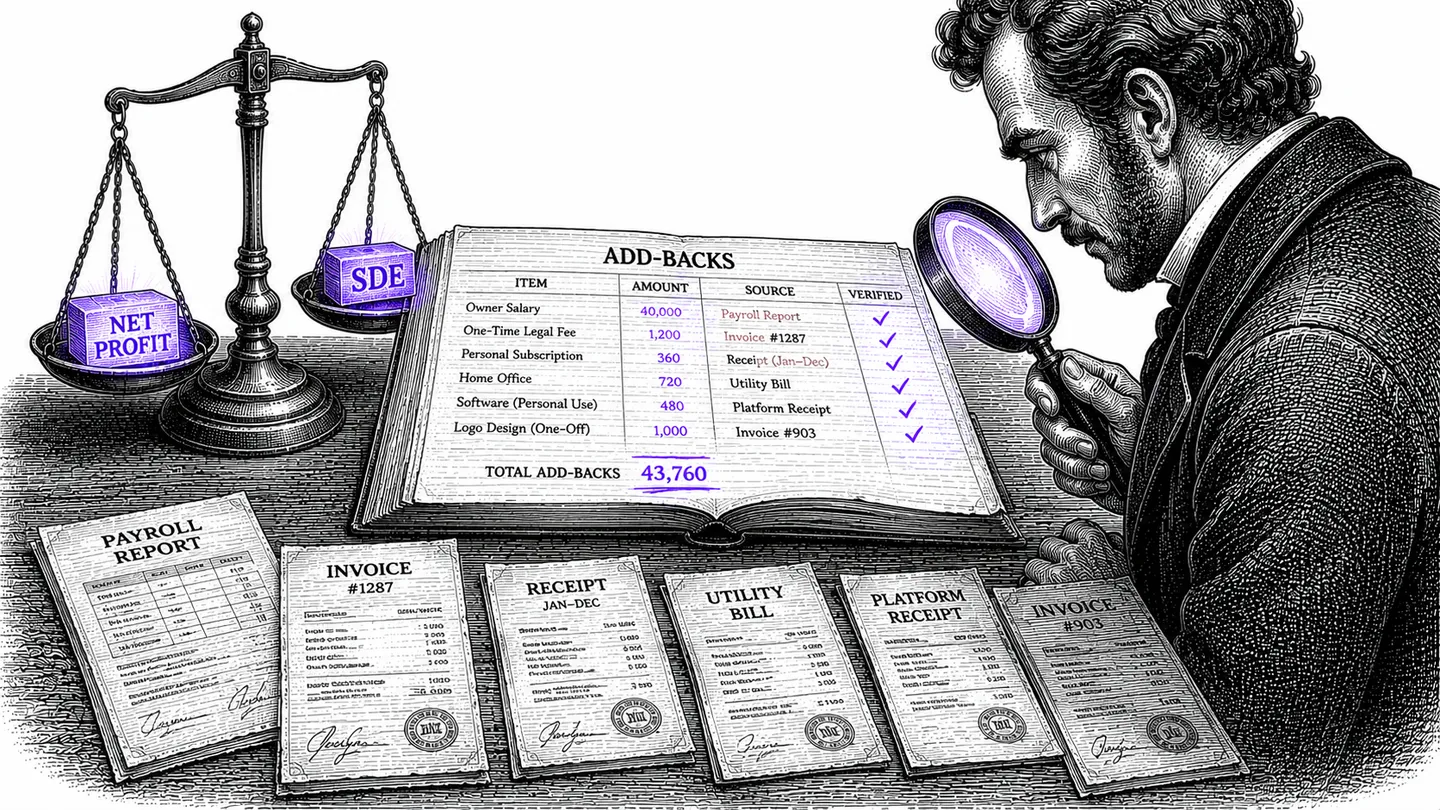
Add-backs are the most misunderstood line in a small-business valuation. Here is what an SDE add-back really is, which ones buyers accept, …

The multiple isn't the answer. Durable profit is. Here's how to price an asset when the foundation is borrowed.