Total Owner Benefit: The Number Sellers Get Wrong (And Buyers Get Right)

In short
Sellers consistently undervalue what they extract from a business. Buyers use exactly that gap to negotiate down.
Sellers of small digital businesses almost always leave a negotiation feeling like the buyer had more information than they did. Often, they're right. Not because the buyer ran a more sophisticated model, but because they calculated something the seller forgot to calculate: the total value the business actually puts in the owner's pocket, across every dimension, in a given year.
This number has a name. It's called Total Owner Benefit. And the gap between what sellers intuit their business is worth and what buyers calculate it to be worth is, more often than not, a Total Owner Benefit problem.
The valuation gap nobody talks about
Price disagreements in small digital asset deals are usually described as differences of opinion – the seller thinks the multiple should be 3.5x, the buyer thinks 2.8x, nobody's lying, people just see value differently. This framing is polite but it obscures what's actually happening.
The buyer is working from a number the seller never calculated. The seller priced the business on revenue, or on what they think they "should" get for it, or on what they've seen similar assets trade at. The buyer is asking a more specific question: what does this business actually give its owner, net of everything, in a year? Once they have that number, the multiple debate becomes secondary – because the baseline changes.
Sellers who calculate Total Owner Benefit before listing are in a different negotiation. They know what number the buyer is going to arrive at, often before the buyer does.
What Total Owner Benefit is (and why SDE alone isn't enough)
Seller Discretionary Earnings – SDE – is the standard starting point for small business valuation. It's revenue minus expenses, adding back the owner's salary (since a new owner might pay themselves differently or not at all in the early period), plus one-time or non-recurring costs. It's a reasonable proxy for the cash a business produces.
Total Owner Benefit goes further. It asks: what is the full economic value of owning this business, not just the cash flow?
The formula has four components.
Owner Cash Flow is the SDE baseline – what the business deposits in the owner's direction after genuine operating costs.
Owner Compensation is the market-rate salary the owner would have to pay someone to replace the hours they're putting in. If the owner is working 25 hours a week and the market rate for that role is $50 per hour, that's $65,000 a year in economic cost that a buyer needs to account for – or a real benefit the owner is currently extracting in the form of their own labour.
Perks are the above-the-line benefits that flow through the business and provide genuine personal value: a work phone billed to the company, a home-office deduction, a software subscription that doubles as a personal tool, conference travel that's partly recreational. These are legal, normal, and invisible if you don't list them out.
Required Reinvestment is the subtraction – the capital the business needs each year to stay where it is. Not growth capital; maintenance capital. The hosting upgrade that happens every eighteen months. The tool subscription that's been deferred for six months but will need renewing. The contract worker who gets called in quarterly. This is cash that technically flows through the profit and loss but isn't real discretionary income for the owner, because spending it isn't optional.
TOB = Owner Cash Flow + Owner Compensation + Perks − Required Reinvestment.
The worked example
Consider a small content SaaS – a niche tool for freelance writers that charges $19/month, with around 420 active subscribers.
Monthly recurring revenue: approximately $7,980. Annual revenue: approximately $95,760.
Operating costs (hosting, email platform, payment processing, one contracted developer for updates): $18,000 per year.
SDE: roughly $77,760. Already a healthy number.
Now the TOB components.
The owner works 15 hours per week managing content, handling support, and doing occasional product updates. At a conservative market rate of $45 per hour, that's approximately $35,100 per year in owner labour embedded in the business.
Perks: a business phone ($800/year), one piece of software used personally ($400/year), a laptop refreshed every three years (amortised: ~$500/year). Total: roughly $1,700 per year.
Required reinvestment: the developer relationship costs $6,000 per year in ad hoc contracts, and there's a platform infrastructure upgrade due every 18 months averaging $2,000. Annualised: roughly $7,333.
TOB = $77,760 (owner cash flow) + $35,100 (owner compensation) − $7,333 (required reinvestment) + $1,700 (perks) = approximately $107,227.
That's a meaningfully different number to the SDE. And it changes what a fair asking price looks like.
Where sellers get it wrong
The three mistakes appear in almost every small business exit where valuation disagreement arises.
The first is forgetting to include perks. Not out of dishonesty – sellers simply don't add them up because they stopped noticing them. The phone is just "a business expense." The laptop is just "normal." When these are excluded from the TOB calculation, the asset looks leaner than it is.
The second is not subtracting required reinvestment. Sellers naturally focus on what the business produces. They're less inclined to think clearly about what it consumes to keep producing. A buyer who asks "what would break if you stopped spending on it?" often surfaces costs the seller hadn't consciously accounted for.
The third is failing to normalise owner labour to market rate. This one is the most significant because it swings the number most. If the owner is working 30 hours a week in a role that would cost $60,000 a year to replace, that $60,000 is either a real cost to a buyer who'd need to hire for it, or a real benefit the owner is extracting by not paying themselves at market rate. Either way, ignoring it produces a distorted picture.
Where buyers use it
A buyer who calculates TOB before making an offer has a different kind of leverage than a buyer who just haggles on the multiple. They can point to specific components – "you're working 20 hours a week in a role a new owner would need to hire for, which reduces effective cash flow by X" – and the conversation becomes technical rather than adversarial.
More than that, TOB calculation surfaces what the buyer is actually acquiring. If 40% of the apparent return is owner labour that the new owner would either have to perform personally or replace, the effective multiple looks different than it does on raw SDE. A buyer who understands this has a clearer view of what the deal really costs.
The negotiating implication is not always that the price should be lower. Sometimes TOB analysis shows that a business is genuinely underpriced – that the seller's pricing was conservative and the real value is higher once all components are properly accounted for. That happens too, and it's worth knowing before you either accept a lower offer or list at a price that undersells the asset.
The one question that cuts through the fog
Before any multiple debate, before any comparables conversation, one question reframes the entire valuation exercise: would I rather own this TOB stream than sell my time elsewhere?
If the TOB is $110,000 per year, and the owner is currently earning $70,000 in employment, the decision calculus looks different than if the comparison is to a senior consulting rate of $150,000. Not because the business is better or worse in either scenario, but because the reference point changes what the business is worth to a specific buyer.
The answer to this question is personal and varies by buyer. But asking it – specifically, with real numbers – cuts through the fog of multiple benchmarking and abstract valuation and returns the decision to the thing that actually matters: does the economic reality of owning this asset make sense for this person, in their specific situation, at this price?
That is the question both sides should be able to answer clearly before any offer changes hands. Total Owner Benefit is the number that makes the question answerable.
More on pricing

A single asking price starts a tug-of-war. A defensible range starts a better conversation. Here's how to build one.
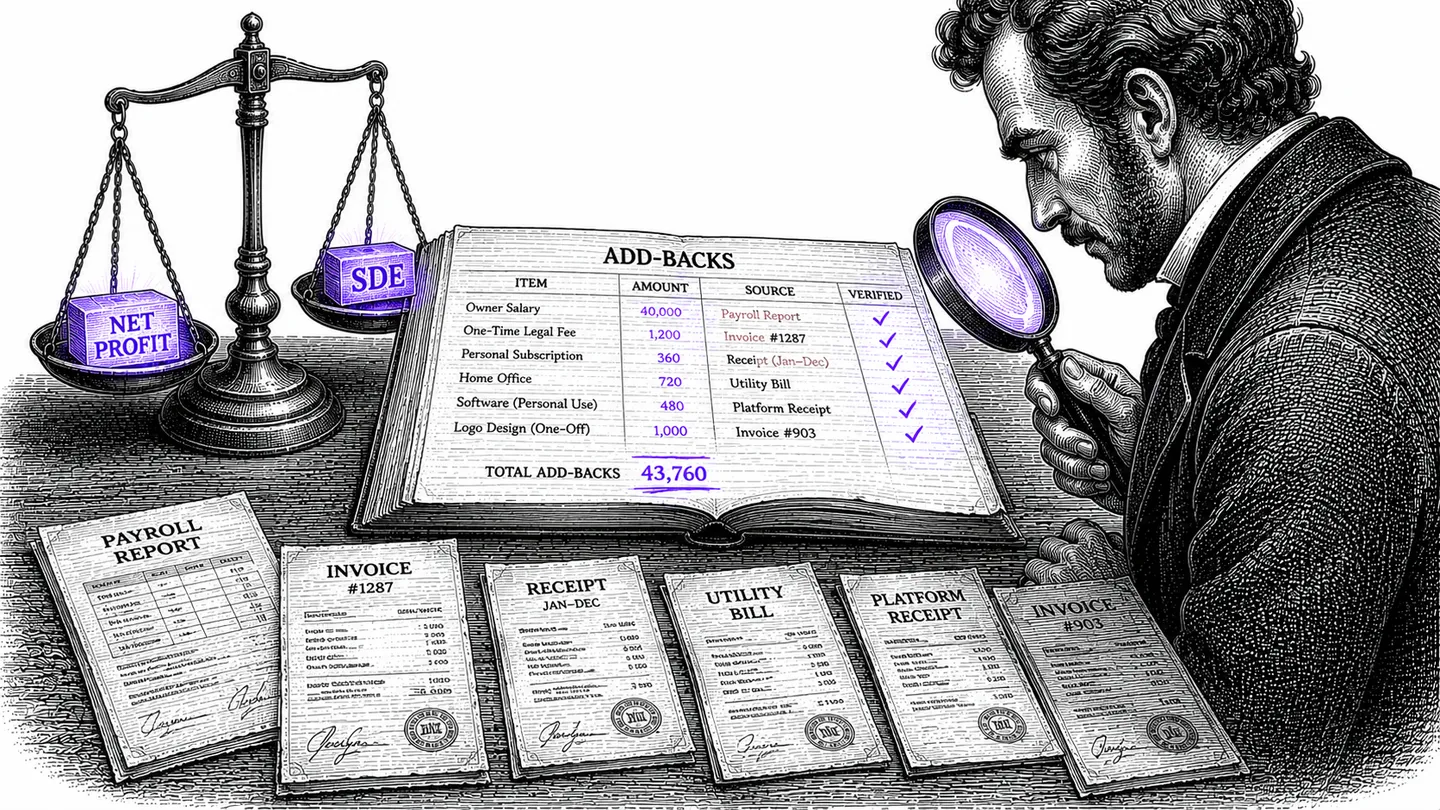
Add-backs are the most misunderstood line in a small-business valuation. Here is what an SDE add-back really is, which ones buyers accept, …

The multiple isn't the answer. Durable profit is. Here's how to price an asset when the foundation is borrowed.