The first week after terms are agreed
In short
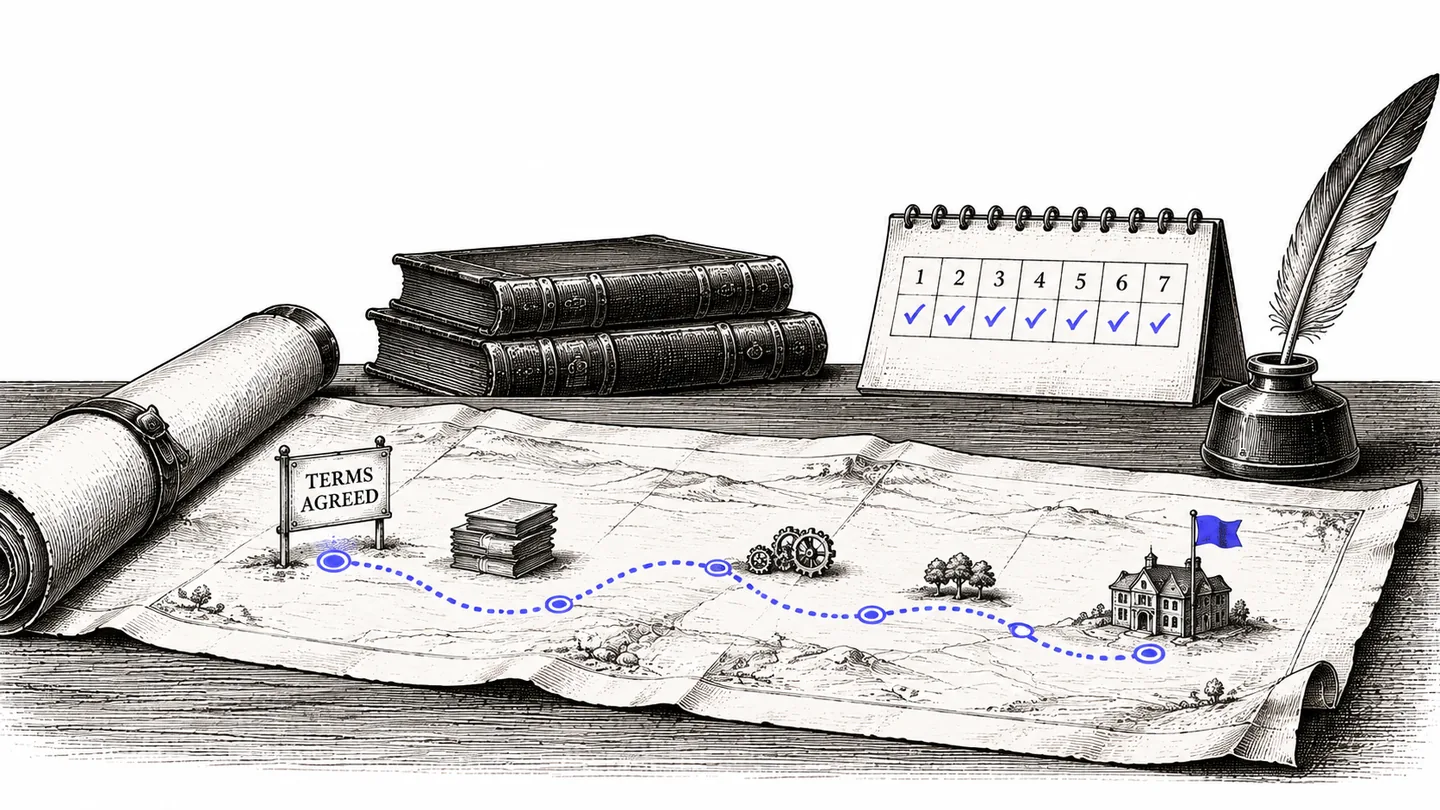
Terms are agreed and the clock starts on the riskiest week of the deal. A day-by-day playbook for the transfer window, from escrow kickoff to the release-and-transfer sequence.
Terms are agreed, hands are shaken, and now the clock starts on the riskiest week of the whole transaction. The deal is not done. It is at its most exposed, because both sides believe it is done and neither has yet moved anything of value.
This is a day-by-day playbook for the transfer window between agreeing terms and closing. Because Indiemaker settles in cash or by wire only, with no earn-out to smooth over a botched handover, this week is compressed and unforgiving. Getting escrow, the asset inventory and access transfer sequenced correctly across seven days is what turns an agreed deal into a closed one.
One boundary first. This playbook covers the transfer week itself, from agreed to close. What happens after the funds land, taking over operations and holding the asset's value, belongs to the first 30 days after you have bought it. We hand off at close and point you there.
What "terms agreed" does and does not mean
"Terms agreed" is a shared intention, not a transfer. It means both sides have settled on a price, a scope of assets and a rough timeline. It does not mean anything has changed hands, and it does not mean the deal is safe.
So treat the week as an exercise in de-risking, not celebrating. Nothing here is a formality. Every step exists to make sure that when funds finally move, they move against assets that are real, complete and genuinely yours. The mindset that closes deals is calm, sequential and slightly sceptical, right up to the moment both sides confirm.
Day 1 to 2: opening escrow and confirming the wire path
Nothing else moves until escrow is open. This is the first action, not the last.
Agree the escrow agent with the seller, escrow.com is the standard choice for deals in this band, and open the transaction. Both parties complete the agent's identity checks, and both confirm the wire instructions directly through the escrow platform rather than over email. This matters, because the payment step is where fraud concentrates, and unverified wire details are how funds go missing. Confirm the account, the amounts and the release conditions inside escrow, where they cannot be quietly altered.
The rule for the whole week starts here: money is held by the agent, not sent to the seller, until assets are verified. Get this frame right on day one and every later step has a safe backstop. For the specific ways deals come apart at this stage, see what kills a deal at the payment step.
Day 2 to 3: building the asset inventory together
The asset inventory is the backbone of the entire week. Everything you verify, transfer and confirm is measured against it, so build it carefully and build it together.
List every asset the deal includes: domains and DNS, the codebase and repositories, hosting and infrastructure accounts, third-party service accounts, payment processor access, any intellectual property, design files, content, and subscriber or customer lists. For each item, record where it currently lives, who controls it, and how it will move to the buyer.
Do this jointly so both sides agree the list is complete before anything transfers. An asset remembered late, after funds have moved, is the classic source of post-close disputes. Our full template is in the asset inventory that turns a scary handover into a boring one, and it is worth using verbatim.
Day 3 to 5: staging access transfer without exposing either side
With the inventory agreed, begin transferring access, in stages, and reversibly. The governing rule is never hand over master credentials before funds are confirmed.
Work asset by asset, using the safest transfer method each one allows. Where a platform supports adding the buyer as a team member or secondary user, do that rather than sharing a password, so access can be granted without surrendering ultimate control. Where ownership transfer is a formal process, such as a domain unlock and authorisation code, initiate it but keep the seller's control intact until release. The aim is to get the buyer close enough to confirm each asset works, without the seller giving up anything they cannot pull back if the deal fails.
This is a genuine parallel effort. Some assets, particularly domains, take time to move, so start the slow ones early. How cleanly each asset stages depends heavily on how transferable it was to begin with, which is covered in what makes a digital project transferable.
Day 5 to 6: verifying assets before funds move
Now confirm that everything on the inventory is real, complete and working, before releasing escrow, not after. This is the check that the price was justified.
Go down the inventory line by line. Log into each account with the staged access. Confirm the codebase is complete and builds. Confirm the domains are moving. Confirm the subscriber or customer list is the size and quality agreed. Confirm the revenue systems are intact and connected. Anything that does not match the inventory is raised now, while funds are still held and you still have leverage, not after they have been released and you have none.
Verifying before release is the whole point of escrow. Skipping it, or doing it after the money moves, throws away the protection you set up on day one.
Day 7: the release-and-transfer sequence
The final day is a sequence, and the order is what protects both sides.
It runs like this. The buyer confirms, inside escrow, that every asset has been verified against the inventory. The escrow agent then releases the wire to the seller. The seller completes the final transfer of full ownership and master credentials. Both parties then confirm the transfer is complete and the transaction is closed.
Each step depends on the one before it. The buyer does not get master credentials before the seller is paid, and the seller is not paid before the buyer has verified. That mutual dependency is exactly what makes the close safe, and it is why the sequence should never be shortcut to save a day.
The parallel checklist: who owns what each day
The reason this week stalls is almost never a single hard problem. It is drift, small items nobody owned, sliding a day at a time until momentum is gone.
The fix is to assign a named owner to every checklist item, each day. Escrow kickoff, buyer and seller both, day one. Inventory, jointly owned, day two to three. Each access transfer, named to the person responsible for that asset. Verification, buyer-led with the seller on hand. Release, both parties in sequence. Write it down as a shared list with owners and dates, and review it at the start of each day. When everyone can see who is responsible for what, nothing slips silently.
Common stalls and how to keep the week on track
A few stalls recur. Wire details arrive late or over email rather than through escrow, so confirm them inside the platform on day one and never act on details sent any other way. Domains move slowly, so start them early rather than discovering the delay on day six. An asset surfaces that was never on the inventory, so keep the list open and add anything found, rather than waving it through. And one side goes quiet, which is why named owners and a daily check-in matter, because silence is easiest to catch when someone is accountable for breaking it.
Run the week this way, sequenced, staged and owned, and the transfer becomes the boring, mechanical process it should be. The deal closes cleanly, the assets are genuinely yours, and you move into ownership. What you do from there is a different job, and it starts in the first 30 days after you have bought it.
More on transfer
Most deals don't die at the price. They die when the buyer tries to figure out what they're actually buying.
Escrow.com is the default way to settle a digital business sale safely. When it is not available in your country, here are …
Escrow is the right way to close almost every small deal. For the handful where it isn't available, here's how a safe …