The Death of Content Websites: Why Indiemaker Never Liked Them Anyway

In short
The SEO gold rush is over – and good riddance. Content sites built on Google’s whims were never real businesses. For indie founders, the smart play now isn’t mourning – it’s pivoting.
Content websites were never especially durable businesses. They were Google-dependent, overhyped, and routinely overpriced. Buyers treated them like appreciating digital real estate, and some paid double-digit multiples of revenue for blogs that a single algorithm update could hollow out overnight. The market has since caught up.
The content website as a standalone asset class is finished.
Google's ranking updates cut traffic to thin, low-value content sites, and AI-generated answers now sit at the top of many search results, absorbing clicks that used to flow through to publishers. Content sites that looked like steady income for years started looking a lot more fragile.
Content itself isn't dead. What's dying is the belief that a content site is a genuine asset on its own.
At Indiemaker, we've listed content sites from the start, and we learned quickly how hard the category is to price. Much of it was low-quality, templated work built for a fast flip. Some sites had genuine value, but the majority were SEO arbitrage plays that were never built to survive a bad quarter at Google.
The easy-money window has closed. If you're still holding a content site, it's worth rethinking what it's actually for.
Why content sites were always a risky bet
Content-only sites were rarely stable businesses. They lived or died by Google's ranking changes. The bigger problem was price: they were frequently valued as if that traffic was permanent, when nobody controlled the channel it depended on.
Unrealistic valuations, and the return to reality
For years, buyers treated content sites like bulletproof investments. In reality they were over-leveraged, fragile, and entirely dependent on a channel they didn't own. We were consistently cautious on the category. A content site earns roughly 2–3x its annual profit when it earns a multiple at all, and that is the honest end of the range. Because sellers set their own asking prices, the spread was enormous, from reasonable listings to genuinely delusional ones.
Blogs priced at double-digit multiples of revenue, with no adjustment for the fact that revenue is not profit? We saw it. Ad-heavy sites pitched as long-term, set-and-forget assets? We saw that too.
The market has corrected. Multiples on content sites came down hard, buyer demand thinned out, and anyone who overpaid in the 2021 frenzy has felt it. Pricing on revenue rather than trailing annual profit is the vanity-metric trap, and it is exactly how people ended up holding inventory nobody wants. This is the same discipline that separates real website investing for bootstrappers from passive-income fantasy: you price on profit you can defend, not traffic you're hoping holds.
The underlying reasons never changed:
- Valued like digital real estate, but with no real ownership. These sites were treated as online property when they were renting space in Google's index. When the rules shifted, the value went with them.
- Ads and affiliates are a weak foundation. If you don't control the product, you don't control your margins. Leaning on ad networks means revenue can drop without warning.
- No durable advantage. If AI can generate your article in two seconds, that article was never the moat. Forgettable, replaceable content is not an asset, and neither is traffic you don't control.
The result is that content sites have faded as a standalone asset class. That doesn't mean the content is worthless. It means the model has to change.
The smart move: pivot or build around it
Flipping content sites for easy profit is over. If you're sitting on a declining SEO site, the useful moves now are about turning attention into something you actually own. There are three worth considering.
Build value from scratch
If your site still gets real traffic, don't just let it bleed out. Build something on top of it. Content alone isn't a business, but it can be the foundation for one.
- Create a product, service, or tool that fits your audience.
- Turn passive readers into paying customers.
- Move off ad networks and start controlling your own revenue.
Own a personal-finance site? Instead of stacking affiliate links, launch a budgeting tool or a paid planning course. If you have an audience, sell them something genuinely useful. That shift, from renting attention to owning an asset, is the same logic behind owning digital assets rather than chasing hype.
Pair creators with makers
Most content-site owners struggle with monetisation, and most makers struggle with distribution. Put the two together. Content drives demand; software captures the value.
A travel blogger with a real audience doesn't have to settle for affiliate links. They can partner with a builder who has a trip-planner tool and sell it directly to that audience. If you have eyeballs but no product, find a builder. If you have a product but no audience, find a creator.
Buy and merge useful IP
If your content site is sliding on SEO, bolt on something with standalone value rather than more ads.
- Small SaaS and tools that solve a real problem. These tend to command higher multiples, roughly 3–5x annual profit, precisely because the buyer owns the product.
- Directories where your audience can interact or transact.
- Utilities and digital products: a database, a template library, an interactive resource.
Own a productivity site? Acquire a lightweight to-do app and integrate it. Instead of watching a content site decline, merge media with a product and build something that stands on its own. Indiemaker lists plenty of affordable projects and assets that pair well with an audience-heavy site, and the case for buying rather than building from zero applies squarely here: a niche audience plus a complementary asset is a faster route to a real business than starting cold.
Final thoughts
We've long been sceptical of content sites as standalone assets. Most were never built to last. That scepticism doesn't leave you stuck, though, because the options are still open. You can build value, or you can buy it.
So the move is straightforward:
- Build a product, service, or tool that complements your content.
- Pair creators with makers to build something lasting.
- Acquire and merge your content with assets that hold their own value.
The content-site bubble has popped. What's left is the ordinary work of building something real.
Browse the listings to see what's on the market, or get the weekly digest for new assets and analysis worth reading.
More on guides

A newsletter's asset is a relationship, and relationships don't always survive a change of author. Here's how to judge engagement over list …
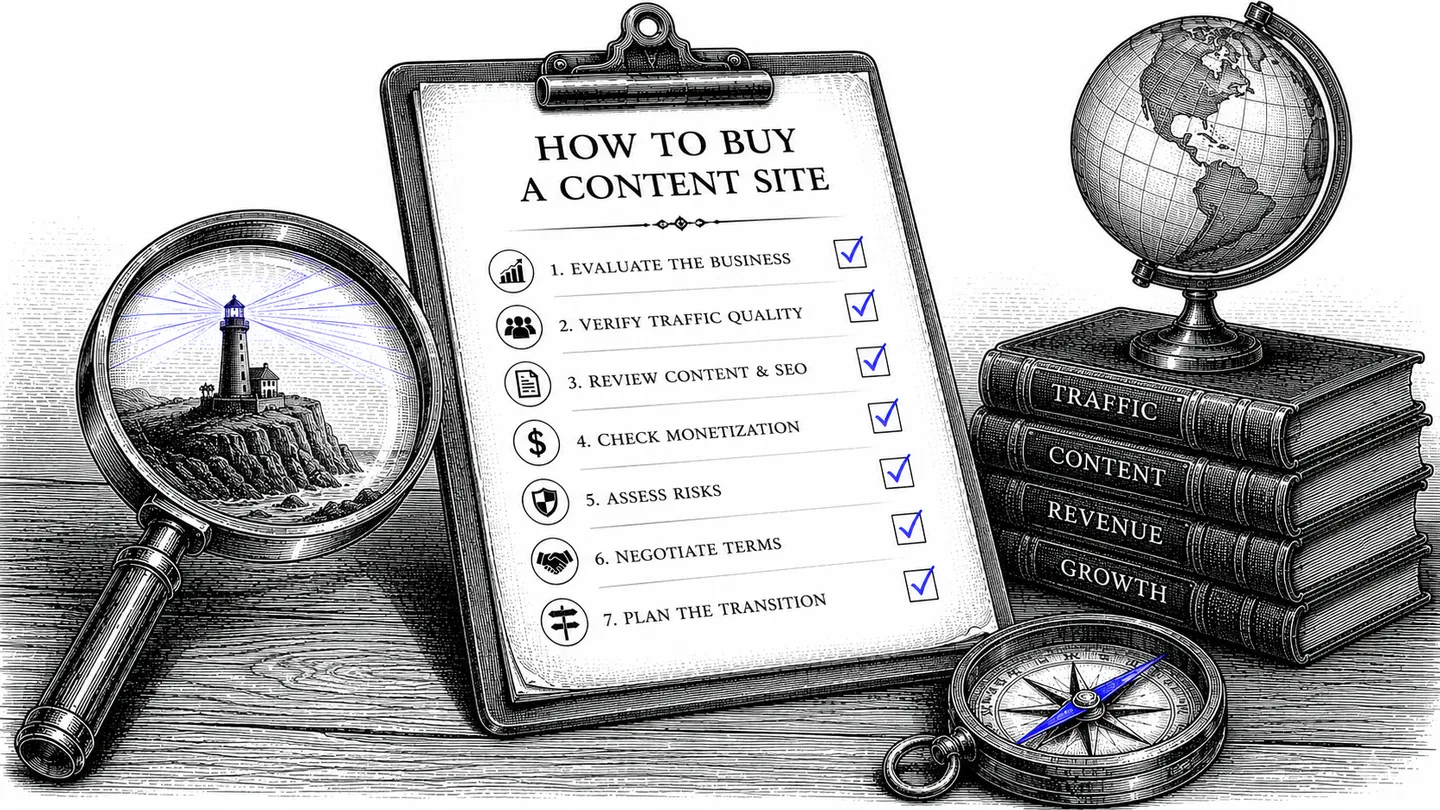
A content site is a bet on the durability of its rankings, and in the AI-overview era that bet has changed. Assume …

MRR is a headline, not a business. Here's how to read churn, cohort retention and support load before you buy a micro-SaaS, …